HOME / TRAINING

ALM TRAINING CATALOG · HANDS-ON TRAINING · ON SITE OR REMOTE · FR / EN

Train your teams on their own equipment.

Five training courses designed by a hands-on practitioner: troubleshooting, artificial intelligence, spare parts, work planning, RCM. Each participant works on a breakdown, a machine or the spare parts stock of their own plant, and leaves with a result the company can measure.

01 — HOW WE TRAIN

Methods applied in your plant, not just learned.

Training only has value if it changes practice on the shop floor. Every ALM course is built so that your technicians, maintenance engineers and managers apply the method as soon as they are back at work.

N°01

Your equipment, your data

No textbook cases. Each participant applies the method to a breakdown, a critical machine or the stock of their plant. The trainer reviews the work and challenges it in writing.

N°02

The need before the tool

Each tool is introduced once participants have felt the need for it, through an exercise or a real situation. People remember what they needed, not what they were shown.

N°03

No lecturing

Short inputs, then discussion and experience sharing between each sequence. Real stories from the food, metals and automotive industries ground the theory in reality.

N°04

Short and regular, remotely

Remotely: short virtual classes on Microsoft Teams, one a week, with brief assignments in between. Your teams learn without disrupting production.

N°05

A shared workspace

A collaborative Padlet board gathers the materials, assignments and group discussions. It stays available after the course, as a toolbox.

N°06

AI as a lever, not the topic

Artificial intelligence speeds up analysis where it helps, always with a critical eye. Decisions and shop-floor knowledge remain with your teams.

01Observe 02Measure 03Analyze 04Make reliable 05Standardize
03 — ReliabilityOn site or remote

DIAGFIAB©: troubleshooting and reliability improvement.

Diagnose fast, fix it right the first time, then trace back to the root cause so the breakdown does not come back. A rigorous, graphical method derived from the MAXER method.

“Repairing is enduring. Improving reliability is choosing.”

Content

  • The principles of diagnosis and the anatomy of a breakdown
  • Define the problem: object, defect, defect-free configuration, differences
  • Build the causal chain (fault diagram) using inductive logic
  • Move from causes to reliability solutions and follow up the actions
  • Handle difficult cases: intermittent, repeat and commissioning failures
  • Facilitate the method with your team

Who it is for

Maintenance technicians and troubleshooters, maintenance and reliability engineers, team leaders, maintenance managers, process, quality or energy technicians, technical directors.

Prerequisites: a few months of industrial troubleshooting experience and a real breakdown from the site to analyze.

What your company gains

  • Less time lost in diagnosis, fewer parts replaced “just to see”
  • No more recurring breakdowns: you treat the cause, not the symptom
  • The return on investment shows during the course: each participant delivers the analysis of a real breakdown in your plant and a costed reliability proposal
  • A common language for maintenance, production and engineering

How it is delivered

  1. Two days of method, in the classroom or in virtual classes, opening with a group troubleshooting exercise that lays the foundations. Industrial cases, forms, practice.
  2. Individual coaching on a real breakdown in your plant, for at least four weeks.
  3. A final presentation: each participant presents their analysis and proposal to a panel made up of members of your management team and the trainer.
Methods and toolsMAXERFault diagramForms F1 · F2 · F3Defect-free configurationRoot causeSolution selection matrix
04 — AIRemote or on siteFR · EN

Augmented maintenance: reliability methods and artificial intelligence.

Reliability methods remain the foundation. Artificial intelligence makes it possible to apply them faster and more widely: analyze hundreds of breakdowns, target the subassemblies that accumulate incidents, write task lists.

“You don’t put a sensor on a component that never fails.”

Content

  • The methods: FMEA, RCM, root cause analysis, an introduction to DIAGFIAB©
  • Off-the-shelf generative AI (ChatGPT, Claude, Copilot…) applied to breakdown history and the maintenance plan
  • A maintenance-specific AI: MaintAI© demonstration
  • Industry 4.0 and IoT technologies: what they bring, when they are useless, and how to use the process sensors already on your machines
  • Keeping a critical eye: AI pitfalls and how to avoid them

Who it is for

Maintenance engineers and managers, reliability engineers, continuous improvement managers.

Prerequisite: access to your company's generative AI for the exercises.

What your company gains

  • Analyses that used to take weeks done in a few hours, and validated by your teams
  • Choose a 4.0 solution based on criticality and real risk, not on a supplier’s promise
  • A structured use of the company's AI, instead of isolated trials
  • A course given by a maintenance professional who sells neither sensors nor platforms

How it is delivered

  1. Remote: virtual classes kept separate from hands-on work, with short exercises in between, done with your company's AI.
  2. On site: two days alternating theory and exercises.
  3. Optional: application to your plant’s real data, with dedicated support.

In French or English, an advantage for groups with plants in France and abroad.

Methods and toolsFMEARCMRoot cause analysisParetoGenerative AIMaintAI©IoT · process sensors
05 — OrganizationRemoteNew

Spare parts: optimize your stock using your own data.

Spare parts account for 20 to 30% of maintenance costs. Yet the person running the storeroom has often been given only one tool, a CMMS that is rarely used to its full potential. This course provides the methods and indicators, applied to their own stock.

“Stock right, consume right.”

Content

  • Measure: stock value relative to equipment replacement value, turnover, dead stock, service level, stock-outs that stopped production
  • Reduce: ABC classification, dead stock disposal, consignment, repair, standardization
  • Make reliable: part criticality, correct references, min-max levels matched to actual lead times
  • AI to clean up descriptions, spot duplicates and analyze consumption

Who it is for

Storeroom staff and stores managers, maintenance engineering managers, maintenance managers. MRO buyers welcome.

Ideal as a pair from the same site (stores plus engineering or maintenance), since most gaps arise where they meet.

What your company gains

  • Across some forty assessments, stock levels were usually 40 to 100% above benchmark values, and stock-outs persisted despite the overstock
  • A quantified savings potential on your own stock
  • Participants leave with a storeroom dashboard, three prioritized improvement areas and a 90-day action plan

How it is delivered

  1. A getting-started session on Teams, Padlet and the analysis workbook: no prior experience needed.
  2. Four short virtual classes, each starting from the participants’ results.
  3. Assignments on each participant’s CMMS extract, reviewed by the trainer, then an individual review.
Methods and toolsStoreroom KPIsABCVED criticalityMin-maxDead stockExcelGenerative AI
06 — OrganizationOn site

Maintenance work planning and scheduling.

Without structured planning, a technician spends barely two hours out of eight with tools in hand. The rest goes on waiting, searching and walking. Planning & Scheduling gives that time back to your teams.

“The what and the how, before the who and the when.”

Content

  • The stakes and the indicators: wrench time, schedule compliance, backlog
  • Planning (the what and the how): work packages, time estimates, parts, safety, coordination with production
  • Scheduling (the who and the when): preventive plan, weekly schedule, scheduling meeting, daily assignment
  • Managing and auditing the backlog
  • Generative AI to speed up writing task lists and summarizing the backlog

Who it is for

Maintenance planners and schedulers, maintenance coaches, team leaders and maintenance managers.

What your company gains

  • More effective technical time, with no extra individual effort: friction is removed
  • Planned shutdowns better prepared and kept on schedule
  • Fewer overtime hours and improvised interventions
  • An organization managed by indicators measurable from the first weeks

How it is delivered

  1. Training at your site: concepts, tools and exercises, with a self-assessment against industry best practices at the end of each chapter.
  2. Immediate application to your real preventive work and planned shutdowns.
  3. An action plan: each participant knows where their organization stands and what to do to improve.
Methods and toolsPlanning & SchedulingWrench TimeBacklog managementJob plansWeekly scheduleCriticality
07 — ReliabilityRemote

Applied RCM: justify every maintenance task.

A maintenance plan must be justified, not copied. RCM (reliability-centered maintenance) links each task to a failure mode and its consequences, on your critical equipment.

“Every task list must answer one question: which failure are you preventing, and at what cost?”

Content

  • Why RCM: the seven questions and the six failure patterns
  • Functions, functional failures, modes and effects, in their operating context
  • Consequences, hidden failures, P-F interval
  • Choose the right task with the decision tree: on-condition, scheduled, failure-finding, or none
  • Revise the plan and roll out the approach on site

Who it is for

Maintenance managers, maintenance engineers and technicians, reliability engineers, preventive maintenance managers.

Each participant picks a critical machine from their site as a running case.

What your company gains

  • Remove preventive tasks that serve no purpose and add the missing ones
  • Finally address hidden failures, those of protective devices
  • A maintenance plan you can defend before an auditor or management
  • Participants leave with the revised plan for their critical machine

How it is delivered

  1. Four short virtual classes, one a week, with industrial application examples.
  2. Three assignments on the real machine: describe the operating context, identify 8 to 10 failure modes with an operator and a technician, then apply the decision tree.
  3. Work reviewed by the trainer between sessions and shared on the group’s Padlet.
Methods and toolsRCMFMEARCM decision treeP-F intervalFailure findingSAE JA1011

08 — OPEN OR IN-COMPANY

One course, a learning path, or a tailored program.

Build a learning path

The courses complement each other. A typical path for a maintenance team moving from firefighting to reliability:

DIAGFIAB©→RCM→AI

And for the organization: work planning, then spare parts.

In-company, at your site

All courses can be delivered for a group from your company, tailored to your equipment, your industry and your data. In English or French, at one or several sites.

In France, courses are Qualiopi-certified and eligible for OPCO funding.

09 — YOUR TRAINER

Teaching it, after 30 years of doing it.

Pascal Flatrès has been a technician, maintenance manager, technical director and plant director in France, Poland and the United States, in the automotive, food and metals industries. He teaches the methods he applied himself, with the mistakes and successes that came with them.
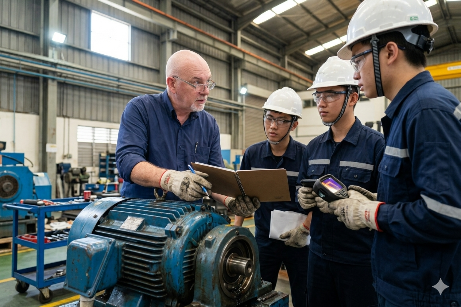
Pascal Flatrès coaching young technicians around an electric motor on the shop floor
Shop-floor coaching — passing know-how on to maintenance teams.

10 — LET'S TALK ABOUT YOUR TEAMS

Which course for your site?

Tell me about your priorities and the challenges your maintenance teams face: let’s see together how to address them.

OPEN AND IN-COMPANY COURSES · REMOTE OR ON SITE · ENGLISH OR FRENCH